
To what extent is social media used for escapism, and in what circumstances?
By Sierra Osborne
December 7, 2021
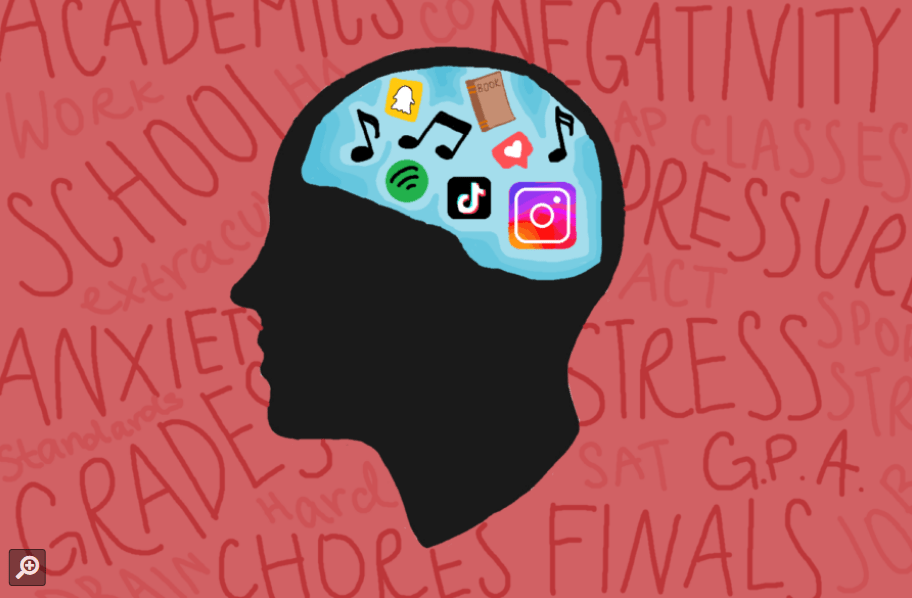
Social media is a form of mass communication that allows users to develop online communities and share and exchange personal experiences or other content. There is free roam under the value of entertainment, and it is borderline endless. New and emerging technologies only fuel the idea of escapism as more and more time is being spent behind a screen than in reality. The issue that presents itself here is the prioritization of social media and entertainment over responsibility. Most of the time this leads to forming a physical, mental, and emotional habit that leads to addiction and eventually to escapism.
Physically, a habit forms when you repeat a certain action enough times that it becomes consistent and instinctual. This in turn can lead to the development of muscle memory. An example comes from people that fidget with their fingers or hands constantly. A more direct example in relation to physical habit with social media is when someone unconsciously pulls out their phone when any sign or infliction of boredom occurs. This repeated gesture then leads to an instinctive need to have their phone on them at all times. That can lead to hours of browsing or indulging in unnecessary content that in turn wastes minutes and hours of the day.
The passage of time itself really becomes relative in reference to social media. Time is not physical, but the way you spend time can be. Social settings no longer become social as most participants escape to technology whenever the opportunity arises. Life events such as dining out, hanging with friends or family, and going out in general, are spent mostly with a lit-up screen. It can be a phone, a tablet, or a TV- all are forms of escapism. Whether these forms of entertainment are positive or negative influences depends on the usage, time spent, and quality of life during and after usage.
Mentally, people are indulging in social media as a mental escape. A primary example comes from the phrase ‘mental break’, which is when an activity becomes mentally draining and strenuous when done for a prolonged period of time, so another form of activity is utilized to place less strain on the brain. Most of the time that ‘mental break’ becomes a need more and more often. Our society has begun to revolve around the need for entertainment and escapism as the world around us becomes more unbearable. This approach has taken a mental toll on the masses as our dopamine reward system is wearing thin and needs more stimulation to continue to produce dopamine.
Escapism is a primary result of a dopamine reward system that feeds off of instant satisfaction. When the brain triggers its first positive response to a specific activity someone does, the amount of dopamine released is at its peak. The more this process is repeated, the initial response doesn’t equal to the consequential ones. So, in order to try and achieve that original dopamine release, we are constantly repeating the activity that caused it. The problem with this is our psychological works on a balanced system. “In addition to the discovery of dopamine, neuroscientists have determined that pleasure and pain are processed in overlapping brain regions and work via an opponent process mechanism. Another way to say this is that pleasure and pain work like a balance.” (Lembke, 2021). That pain can come in many forms, such as mental fatigue, which then most of the time leads to mental illness.
Emotionally, we are destroying ourselves. Our own minds are feeding into a constant cycle of pleasure and pain just by simply overindulging in social media. The result of abusing our dopamine reward system is mental fatigue that is turning into mental illness. This then goes to affect our emotions, a direct result of mental stress. The addiction to social media has become borderline relatable to symptoms common in drug abuse cases. “Similar to drug addicts, excessive social networking site (SNS) users display a preoccupation with social media platforms when they are not using them, mood modification when they access these sites, and tolerance to the social rewards obtained on these sites from interactions. These excessive SNS users also experience conflict with others because of their use, and when attempting to quit, they display withdrawal symptoms and often relapse.” (Hilliard, 2019).
What comes from these mood swings is mental illness. It is evident in today’s society that anxiety and depression are on the rise. People are comparing themselves to others more frequently as it is available online, especially in celebrity interaction. You are able to follow them around on their daily adventures and day-to-day activities. You see what they are doing and compare it to what you can and cannot do. The idolization of celebrities or other people, in general, is leading to lower self-confidence and image issues. Obtaining the latest tending item or technology is more of a priority as a materialistic need than a want. Mentally, it is draining. But emotionally, it is more detrimental. Feelings of worthlessness arise when you cannot have what someone else does. Unfairness becomes so important that we tend to forget the basic needs we are allowed to meet are not met in other places around the world.
Social media is ruining relationships with ourselves, as well as with other people. It has become a physical, mental, and emotional escape from everyday life and responsibilities.
There is the argument that using social media as a form of escapism is positive. An amount of people use social media to rant, relieve stress, and connect with other people that share like-minded ideas. But, when that escapism starts to turn into a dependency, it can become toxic. Day-to-day functions cannot be seen fit without some form of interaction with social media and instant entertainment. People would rather stay in and binge shows or social media activities rather than interact with the real world around them. Social media has become a crutch.
A majority of the population beyond the young and technical savvy have an issue with using social media as escapism. The demographic most affected by its use though is teens and young adults. This also ties into the needs that society and the school system have failed to meet for them.
Specifically, a large amount of gifted, or advanced, students tend to rely on social media as a form of escape from the suffocating responsibilities placed on them. On the other hand, it is out of sheer boredom. They are either being too challenged or not challenged enough. Either way, this results in a mass population of burnt-out kids that still suffer into adulthood.
There is a name for this known as the ‘Gifted-Kid Burnout’. The biggest presenting factor is the idea that gifted kids are burnt out by being paralyzed by their own potential, as well as what everyone else expects of them. Most of these kids read a lot of books or indulged in specific time-consuming hobbies to occupy themselves, and then when presented with mass media quickly left those activities. Books became no longer enjoyable to read as the dopamine reward from that faded and was replaced with easy entertainment. Failure of the education system to adhere to and challenge young minds that were more developed than the average kid resulted in a large mass of burnt-out kids from boredom and lack of applying themselves. “Gifted-Kid Burnout can provide people with a good narrative explanation as to why this should be: your life hasn’t turned out the way you wanted it to because, as a child, your exceptional gifts meant that no one bothered inculcating in you the key skills and psychological coping strategies that, it turns out, real people need in order to thrive as adults in the real, adult world.” (Whyman, 2018).
Using social media as escapism ties into the category of procrastination. A lot of the reasons why young people of any age attending school are burnt out can be sourced from procrastination. This ties into the aspect of time as more of it is being spent in social media than studying or doing homework ahead of time. “Kohler concluded that media use for escape can certainly be a form of procrastination, but not all media escapism serves this purpose.” (Pychyl, 2015). For the media escapism that does serve the purpose of procrastination, it will be utilized as a distraction to not have to deal with impending responsibilities that lie ahead.
There is also the social and school factor. Students are surrounded by other students that can either determine what is trending or pass it along. The domino effect is in high play when at school, no matter the age. If one student is doing something interesting, another will want to know what it is or try to participate. If a mass of students indulges in a certain form of social media that provides entertainment, or even popularity, others will want to engage in it as well. This form of interaction feeds into the idea of escapism and procrastination. Spending time with like-minded people that also engage in large time spans of social media with eventually influence other members of the friend or family group.
Environmental factors have an even larger influence, especially with regard to COVID. In reference to the younger population that attends middle and high school, responsibilities such as bills, and work, are slim to none. They spent most of their time indoors and surrounded by technology that connected them to daily classes. Although beneficial to the physical health of the students, their mental health was drained. Little to no physical interaction in the real world with friends and family led them trapped inside the house. Some key components of learning come from in-class immersion. Teachers held little control over students beyond attendance, participation, and assignments. A majority of students allowed the ease of access to technology to take up their time and scroll through social media or become distracted. Knowing that if they just signed onto zoom and opened another tab to play games meant they could still pass the class, a lot of students took advantage.
Escapism through social media also comes in the form of comfort. In the circumstance that someone’s home life is not accepting or toxic, many teens turn to social media for what they’re lacking at home. Verbal abuse, physical abuse, mental abuse, sexual abuse… All of these are very suffocating and draining circumstances that unfortunately a portion of the population has to live with. Most residents in the home do not have anywhere else to go. Some are forbidden from discussing their home life with people they trust for fear of punishment. Some do not share due to shame. Social media in this instance may still be a form of escapism, but it also becomes an outlet. In some cases, reliability on social media is what retains someone’s mental health and relieves stress. Connecting with other people online also allows individuals that are more introverted to be more comfortable in a social setting. They are not required to maintain a physically intimate conversation, and the option to leave is available at any time. They can also choose who they wish to talk to and have a greater chance of finding people they are comfortable with rather than having to approach them in real life.
A lot of social media users through gaming platforms develop friendships and join support systems that may be totally different than the environment they’re surrounded by. Social media also doesn’t require you to name yourself, you can remain anonymous. The anonymity of participating in certain things and saying what you need to and not being traced back to your home and family is what gives a majority of users that safe space they need. Most users that play video games also use them to bond with others with the same interests. There is also the argument that it releases stress and stimulates creativity. Depending on the genre of the game played, various things can occur. Shooter games tend to focus on the competitive side while roleplay and world-building games tend to focus on creativity and freedom to explore.
On the other hand, there are people that use social media as a negative outlet. Poor anger management can become fueled when contested by alternate opinions or statements. Some people use social media anonymity to spread hatred and vent their anger as they see fit. This action is not only harmful to the receiver but also to the giver. A repeated pattern of using social media to express negativity will lead to reliance on that outlet to exert it. In turn, they will associate social media with negative attributes and ruin the experience for others. When there is a lack of consequences in doing so, they may heighten this behavior. The ease of doing so without repercussions can in turn lead to the idea that they can allow this negativity to trickle into the real world and others around them. Frustrations brought in from absorbing negative social media will begin to reflect in their day-to-day life. Allowing a negative experience to affect someone mentally will in turn make them more susceptible to negative thoughts and interpretations. This in turn can lead to easy irritability and lack of self-control.
As for the kids growing up in this environment, escapism through social media is as common as watching television on a Sunday afternoon is. Parents are allowing technology to teach and entertain their kids instead of allowing them to abstain from artificial life. They spend more time with their face plastered to an iPad because parents don’t want to deal with their temperament issues, or parents aren’t well enough equipped to their role as a caregiver. It is easier for parents to let their kids indulge in social media than to find alternate modes of activities. In turn, those kids develop attachment issues to their technology which make it harder to take away. Thus, a vicious cycle occurs and the only way the child is happy is if they have their social media. Parents have allowed kids to place a possessive hold over technology and it has caused an issue with early addiction and dependency.
Social media is used to a great extent for escapism. The physical, mental, and emotional escape from reality can become detrimental to someone’s well being or it can enlighten it. The consequences that follow come from the type of usage and the amount of time spent in use.
Further research can be conducted around why social media is used so often for escapism. Beyond general use, the limitations and management of social media users need to be discussed and acknowledged. A majority of the youth are growing up in a world surrounded by technology and expectations that what is on the screen needs to dictate their life. Society has neglected the responsibility of overseeing how mentally affected the youth are by societal expectations in relation to social media.
 Sierra Monet Glasgow